Sunday, 11 December 2016

Point Break.

Point Break.

Point Break is a crime, action film directed by Ericson Core in December 2015. The film stars Edgar Ramirez, Luke Bracey and Teresa Palmer and is about an FBI agent who wants to take down a group of extreme sports athletes who are committing crimes.

Through out the film the audience are introduced to a variety of different extreme sports. These scenes are important because it makes the audience feel as if they are apart of the action. Along with the content of the scenes and the cinematography is also significant because it physically puts the audience in to the extreme sports. This makes the audience more involved with the film meaning that they are more likely to relate to the characters. The whole idea behind the film is to show the extremity of extreme sports. This is supposed to add a thriller element to the film which draws in the audience. The cinematography plays a vital part in the film because it shows the audience a different perspective and experience. This follows the idea that people watch films as a form of escapism.
The whole idea of the film is that the criminals are trying to experience the world by doing the variety of extreme sports, but also want to give back to the planet by doing certain acts that they don't see to be crimes. This explains why the characters do what they do and why they are willing to put their lives at risk to 'experience' the world. This adds another action thriller element because the audience know that they will put themselves in life or death situations and any one can die at any moment.

Monday, 5 December 2016

The Longest Ride

The Longest Ride

The romance drama, The Longest Ride, was directed by George Tillman and written by Nicholas Sparks (Novel). It was released in April 2015 and stars Scott Eastwood, Britt Robertson and Melissa Benoist. The film is about a young couples relationship intertwining with a past relationship of the old man they start to become friends with. The film has themes of Love, Death, Masculinity and Loyalty. 

Nicholas Sparks's style is very clear through out the whole film. Typically, Sparks's stories do not contain a human antagonist which is evident in this film. The screen play was written by Craig Bolotin but the film still is heavily influenced by Spark's style. The main antagonist in this film is the interests of both Sophia (Britt Robertson) and Luke (Scott Eastwood). Sophia is moving is planning on moving away to go to fulfil her dreams of working with in the art world and Luke is a bull fighter who has risked his life one to many times. This is significant because their contrasting lives both bring them together and pull them apart. This means that the audience doesn't have an physical antagonist that they can blame for everything going wrong. 

Another important aspect in the film is how the story of the old mans (Ira) relationship is told. The use of flashbacks is used to not only bring Ira and Sophia closer together but to show the similarities to the audience between the old relationship and the new relationship. The flashbacks allow the audience to see the parallels between the two generations which is important because there are two stories that are going on at the same time. Also by seeing Ira's old life means that when it gets to the end of the film and we see why a specific painting is so important to Ira the audience is able to understand the emotions. The flashbacks (editing) is important in this film because it helps the audience to visualise how similar the stories are rather than being told they are similar. The audience can work out the connections themselves.

Saturday, 26 November 2016

Footloose!!

Footloose. (2011)

Key Cast: Julianne Hough, Kenny Wormald, Miles Teller.
Director: Craig Brewer
Writer: Dean Pitchford
Genre: Music Drama
Themes: Family, Dance, Friendships, Relationships and Confrontation
Release: October 2011
Budget. $24,000,000


Key Scene:
A key scene is when Ren is pulled over by the police because his music is playing to loudly in his car. This is important because this is where the audience are introduced to the rule that they have in this small town. It also shows how strict the rules are and why they take things so seriously. This gives a reason as to why the teenagers are so desperate to dance because they have been told they are not allowed to. The audience being told the strict rules on things that we would think are normal also show why the characters in the film take it so seriously and why they do the things they do.
Another key scene in the film is when Ariel ad Ren are at the train tracks. Ariel decides to stands on the track in the path of an oncoming train. Ren tries to persuade Ariel to get off the tracks but she is ignores him and remains on the track as the train gets closer and closer. In the end Ren has to save Ariel by pushing her out of the way of the oncoming train. This is an important scene because if Ren wasn't there, the audience could assume that Ariel would have let the train hit her. This shows that Ariel is not happy with everything that is going on. This event also links with other events in the film where she becomes reckless and irresponsible, but this event in particular shows to the audience that although she puts on a tough face she is still suffering and grieving from the accident that took place three years ago.

Microfeatures:
An important micro-feature in Footloose is editing. The film starts by showing the car accident and the town changing the laws because of it. The Law basically states that no one is allowed to dance because they believed that the party the people went to was the main cause of the accident. The audience is first introduced to the character Ariel and she is shown to be innocent as she is wearing a floral dress which the audience would associate a younger child wearing. The editing is important in this film because it shows a 3 year time jump between when we see first see Ariel and then when we see her for the second time. However, she has changed dramatically as she is no longer shown as the innocent little child but she is now shown as more independent and rebellious. She is wearing small shorts and tight tops which is the complete opposite as to what the audience have already seen of her. The editing, in particular the time jump, shows how the accident and the law has changed Ariel. Although we don't actually see what has happened in those three years, we know that she has gone through something difficult. The editing helps highlight why Ariel does the things she later does in the film and why people see her in a different way. The editing shows that even though it has been three years since the accident, no one has forgotten about or moved on from it. It is having a long lasting affect.

Monday, 21 November 2016

Safe Haven!!

Safe Haven

Key Cast: Julianne Hough, Josh Duhamel and Colbie Smulders.
Director: Lasse Hallstrom
Writer: Nicholas Sparks (Novel)
Genre: Romance Thriller
Themes: Love, Abuse, friendship, Family and Secrecy.
Release: February 2013
Budget: $28,000,000

Key Scene:
A key scene in the film is the opening scene. The film opens with a girl running out of a house covered in blood. This straight away shows the audience that the genre of the film is thriller. The audience are left in the dark and they are not quite sure as to what is going on. The audience start to make ideas based on what could be happening or what happened to her. The following scene then shows the girl to be running away from the police. This backs up the idea that something is wrong. The opening scene is used to show the audience that even though the film is predominantly a romance film, it still has thriller elements to it. Because the audience doesn't find out till later what the opening scene has to do with the mani protagonist, they are left trying to connect the dots and figure out why the main character is relevant.
Another key scene is when Katie has to face her past in order to save the family she loves. In this scene, she shows to the audience that she is willing to sacrifice herself if it means that she can protect Alex, Lexi and Josh. This scene is significant because it reveals more of her personality. Even though the audience may not be able to relate to her story they can still relate to the fact that she has unconditional love for her new family. Another reason why this scene is important is because when the audience see why she left her home to move to Southport, she is shown to be weak and powerless. However, when she comes to face her past she makes sure she does something about it and she becomes more powerful and independent. The scene shows that she has evolved because of her new experiences.

Key Micro-Features:
A key micro-feature in the film Safe Haven is Editing. At points through out the film we see flashbacks of Katie's past life. They usually are shown when Katie reacts negatively to a certain present day action (e.g when she talks to a police officer). The editing is important because the quick flashbacks that the audiences does see adds to the thriller aspect of the film, because we are constantly reminded that there is an underlying story within the romance. The flashbacks also reveal more of the story each time until eventually all is revealed. This is significant because it makes the audience think more rather than give them all the answers which is why the editing is so important.
Another important micro-feature is performance. In the majority of the film, Katie is living a double life. Whilst having a new life and identity she cant escape her past as there are constant reminders and she still lives in fear. She is trying to move on but she is finding it difficult. The performance is important because she has new life in which she is happy but every so often her old life breaks through the cracks. The performance still has to be convincing in order for the relationship between Alex and Katie to be real but also show her old self in order to show the audience that there is still something wrong.

Saturday, 12 November 2016

The Thinning

The Thinning

Key cast: Peyton List, Logan Paul and Lia marie Johnson.
Director: Michael J Gallagher 
Writer: Michael J Gallagher
Genre: Thriller
Themes: Post apocalyptic, Friendship, Deceit
Release: October 2016


Key Scene:
A key scene in The Thinning is when Laina manages to find the real test results. The test results decide which students live or die as the test is used to bring down the American population The audience already knows that something strange is going on as Laina is shown to be one of the smartest, but he failed the test. When Laina finds the real results it shows that she got the highest score but was still 'sentenced to death'. This scene is important because it shows that there is more to what is happening and that there is a deeper problem. This makes the audience question the system and also question what they already know about what is happening in the film.
This leads on to the next important scene, which is the end scene. In this scene we see a large group of children, unconscious, getting sent under ground. This is significant because again it makes the audience question everything. The children being sent underground are the children that we saw from the high school who failed the test. The scene that follows shows a factory setting and shows people working, making different product. Then the audience sees a recognisable character. This is important because it contradicts everything the audience knows. These two scenes together are important because the story completely flips and the audience are left confused as to why the things happened in the film happened.

Key Micro-features:
A key micro-feature in the film is Cinematography, specifically lighting. Throughout the majority of the film the lighting flickers on and off. This is important because when the lights go off, the audience cant see anything. This builds the tension and is a common techniques used in thriller films. The lights flickering on and off builds the suspense as the audience cant see everything that is going on, so whilst the lights are off anything could happen. The lighting is significant because it is integrated into the actual story/plot of the film. This is significant because it puts the audience in the same position as the characters in the film because when the audience don't see anything, the characters don't see anything. This means that there is more suspense in the film because anything can happen to the characters in the dark.
Another important micro- feature is mise-en-scene (location). The film is mainly set in a high school where they go into lockdown when the test is being taken. The school is surrounded by wired fences and locked gates. This adds to the tension in the film because the audience realise that they is something obviously wrong and that the fences and locked gates must be there for a reason.

Saturday, 5 November 2016

Beyond the Lights!!

Beyond the Lights.

Key Cast: Gugu Mbatha-Raw, Nate Parker, Minnie Driver
Director: Gina Prince-Bythewood
Writer: Gine Prince-Bythewood
Genre: Romance Drama
Themes: Relationships, Mental Health, Suicide, Fame
Release: November 2014
Budget: $7,000,000


Key Scenes:
A key scene within the film is when Noni is in her apartment and has destroyed the photos of her hanging on the wall. This is a key scene because when Kaz comes in to help her she says, ' I feel like i'm suffocating in the middle of the street and no one can see me dying". This links with what she said at the beginning of the film ("No one can see me") and suggest to the audience that in the music industry everyone ignores the problems as they can only see the person that has been made by the media. The audience before, think that being famous is the best thing in the world and that it comes with so many perks, yet this films shows the flip side to fame. This scene in particular shows to the audience that even thought there are so many eyes on Noni, no one can actually see the real her and the pain she is facing. This scene is significant because after this everything starts to change. She goes away with Kaz to get the break she needs and she starts to realise that the person she is was is not the person she wants to be and she starts to become more confident in herself.
Another important scene in this film is when Noni is performing with Kid Culprit and rather than taking off her jacket mid performance to reveal the little clothing she is wearing she keeps it on to keep herself covered. This shows to the audience that she is visibly uncomfortable with the things she has to do in order to impress everyone else. Whilst Kid Culprit is fully clothed, Noni is forced to wear only under wear on stage whilst Kid Culprit gets to use her as an (over-sexualised) object. Up until this point in the film, Noni is shown to be a sexual object by the way that she dresses and the way she acts in her music videos. Now, when she tries to go against this she gets hated on by Kid Culprit and the audience, which shows that women are made to act and look a certain way and if they don't, they are seen as not good enough. She is clearly uncomfortable with the things she has to do and shows to the audience that she doesn't want to act like the girl they see on tv, but to be just Noni.

Key Micro-features:
A key micro-feature in this film is mise-en-scene. This is significant because it juxtaposes with Noni's character. She is shown to have the perfect house, fancy cars and a private jet she can use on demand. This is important as, like i have mentioned before, the audience think that being famous and having everything makes someone happy when in fact we can see that that is not the case. By showing Noni to be unhappy and also putting an emphasis on mise-en-scene shows to the audience that although everything seems okay doesn't mean it necessarily is.
Another important micro-feature is cinematography. There is a scene towards the end of the film when she sings Blackbird and the camera focuses on Noni. This is signifiant because all the other times we have seen Noni perform it is all about the performance and the way she looks. However by the camera simply just focusing on one side of Noni shows that it is not about the way she looks or the character that she has played but it is about her and her talent. By the cinematography just showing the actual Noni makes the audience see and listen to her more. She is not hiding behind anything and she becomes like the little girl we saw at the beginning of the film.

Comparable:
This film is very similar to Bodyguard (1992) as it has the same concept of the man being the one to save and help the girl. They have similar themes in which they both address the negative issues of being famous and how it is not what it is sometimes made out to be.  You could argue that Beyond the Lights is a modern day Bodyguard but I think that Beyond the Lights looks at more real life issues and it isn't about being saved from someone else, it is about being saved from yourself.

Monday, 31 October 2016

The Escort.

The Escort

Key Cast: Lyndsy Fonseca, Michael Doneger
Director: Will Slocombe
Writer: Michael Doneger, Brandon A. Cohen.
Genre: Romance Drama.
Themes: Relationships, Addiction, Friendship, Family
Release: July 2015
Budget:?


Key Scenes:
A key scene in this film is when Natalie goes to a meeting to become a grad student. What is important about this scene is that when she goes to the meeting she automatically assumes that she is not going to get in because of her background and what she has done in the past. However, the interviewer explains how it doesn't matter about her past but the potential she has now, which is a significant part of her story. She under estimates herself because of what people know her for and how people see her. What is also important about this scene is that it helps her realise that she needs Mitch. Mitch followed the same kind of idea where he didn't care about what she did but who she was as a person. The whole film is about not judging people before you get to know them. The whole reason why Mitch chose her was because he wanted to know how someone so smart gets into the escort business. After getting to know Natalie he didn't judge her but accepted her for who she was and never made her change. This scene is important because it shows that it doesn't matter who you are or what you do, you can still be able to do the things you want.
Another important scene is at the end of the film when Natalie confesses that she has fallen for Mitch. This is significant because through out the film she has a negative idea of love and relationships, so she puts up a wall. As we see Mitch and Natalie's relationship grow the audience is unsure as to whether the relationship is going to work because of Natalie's job and her views on love. However at the end of the film she decides to knock down her wall and tell Mitch how she feels about him. This is important because it shows that they both helped each other get out the lives they didn't really want.

Key Micro-features:
A key micro-feature in this film is mise-en-scene, in particular location. The location is important because at the beginning of the film we see Mitch living in a messy and small apartment and we first meet Natalie in a night club. However by the end of the film we start to see both of the characters outside their usual surroundings. Mitch comes from a rich family background and in the film ends back in his big family home and we start to see Natalie less and less in nightclubs. This is important because it shows the development in the two characters. Both the characters were in places they thought they wanted but were not really happy about the lives they were living, but by the end of the film they had the happy lives that they didn't know they really wanted. The change in location through out the film is significant because it shows to the audience that by the two characters meeting they were able to move to a better place.
Another key micro-feature is performance. This is because both the characters deny that their is something wrong in their lives. They come across as if they know what they are doing and that they are where they want to be. Both characters act oblivious to their surroundings and how it impacts others. The performance is important because the characters have completely different contrasting personalities, however they are able to connect because they have a common problem.

Wednesday, 26 October 2016

Bowling for Columbine.

Bowling For Columbine

Key Cast: Michael Moore
Director: Michael Moore
Writer: Michael Moore
Genre: Documentary (Crime)
Themes: Violence, Gun Crime, Politics, 
Release: November 2002
Budget: $4,000,000

Key Scenes:
A key scene within the documentary is shown right at the start of the film where Michael Moore goes into the bank. This scene is significant because it is sort of an introduction into what Michael Moore is going to be presenting. The audience thinks that it is going to be a serious documentary about gun crime, which it is, but Michael Moore almost mocks gun control as he shows there is really no gun control. When he walks into the bank the first thing he says is that he wants the bank account were he can get the free gun. Then after he goes through the easy process of the getting the gun he then says 'Do you think it is a little bit dangerous to be handing out guns at a bank'. This is a significant part of the scene because he has a point. He shows to the audience that in aAmerica it is so easy to get access to guns and you can almost buy them any where. By opening the documentary with the scene at the bank shows that America is such a gun oriented country that they are even selling them at banks; the last place which you would assume to sell them. Michael Moore mocks the fact that people are completely oblivious when it comes to weapons.

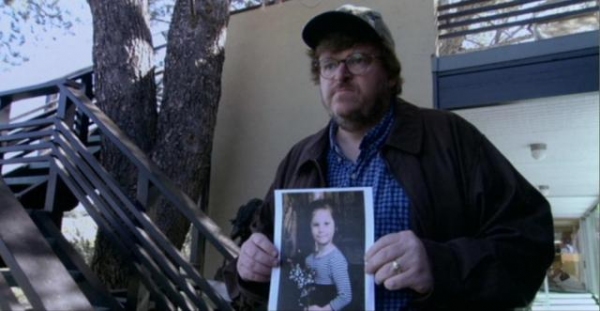
Another important scene is shown at the end of the documentary when Michael Moore goes to talk to Charlton Heston (Famous member of the National Rifle Association (NRA)) about his views on guns and why he promoted guns at the scenes of recent gun crimes. This is a significant scene because, Michael Moore decides to confront him about Kayla Rolland. Moore decides to confront Heston about the little girl and wanted him to apologies to the town for his actions, but he refuses. This is significant because it shows to the audience that a lot of people in America think that guns protect them, but when gun crimes do happen they don't learn from them. They are oblivious to the fact that any one can get a gun and any one can do what ever they like with them. Moore confronting Heston about the death of Kayla is significant because it tells the audience that although people know that guns are a major problem people try and push past or forget about it.

At the NRA rally a few days after the columbine shooting, Heston said: 'From my cold dead hands' as he held a rifle in the air. I think this is also significant because he is promoting rifles after there was a mass shooting in a local school. He is almost rubbing the towns nose in it that they are still supporting guns after a massive tragedy. It indicates that people are completely oblivious and unaware of the negatives impacts that guns have on peoples lives. 

Key Micro-features:
Two key micro-features that work together is mise-en scene and sound. In a scene about halfway through, it shows a montage of weapon related deaths (including bombings and shootings) in which the song What a Wonderful World is playing over the top of it. This creates juxtaposition and makes the audience think more about what they are seeing and what they believed. America is known as one of the greatest countries in the world. This idea is constantly reinforced in the media as it often highlights how proud people are to be in America, 'The Land of the Free'. However, the juxtaposition between the scene and the music shows the exact opposite. It shows parts of Americas negative history when it comes to weapons and how it is not actually what it is made out to be. Again Michael Moore is mocking the audience and showing them that there is a problem that is not being addressed but being forgotten about. Mise-en-scene and sound works well together to create meaning in this scene because it indicates that what we are hearing about America is totally different from what is actually happening.

Monday, 17 October 2016

White Bird in a Blizzard.

White Bird in a Blizzard.

Key Cast: Shailene Woodley, Eva Green and Shiloh Fernandez.
Director: Gregg Araki.
Writer: Gregg Araki.
Genre: Mystery Crime Thriller.
Themes: Family, Betrayal, Relationships, Friendships, Deceit. 
Release: September 2014


Key Scenes: 
An important scene within the film is when Kat Connors (Shailene Woodley) starts to become suspicious of almost everyone she cares about. As she starts looking into what could have happened to her mum, she starts to doubt and question people. Throughout the film she constantly gives off the impression that she blames her mum for leaving them and that she doesn't care about her mum anymore. This is significant because she puts up a wall through out the whole film but as soon as she wants answers she starts to care for her mum. This implies to the audience that she has always wanted to understand why the things that happened, happened. When she starts to become suspicious of everyone the only person who she truly wants to trust is her mum.
Other important scenes in the film is when she has dreams about her mum being lost in the snow. Along with the title of the film it is suggesting that Kat desperately wants to find her mum but there are obstacles in her way that she cant control. Also the idea of Kat referencing snow with her mother, foreshadows the events to come. This is also implies that Kat has subconsciously known the whole time what really happened with her mums disappearance.


Key Micro-features:
A key micro-feature in the film White Bird in a Blizzard is performance. The performance is important in the film especially concerning the protagonist Kat, as she is always trying to make herself appear older than she is. In the film, she directly targets older men in which to have a relationship with. She goes for the police officer who is in charge of her mothers case. This could imply that she wants to move away from her child hood as it comes with bad memories. She also references in the film that when she was growing up her mum was almost jealous of her. Her performance in the film suggests that she wants people to see her as older and more mature, meaning she is trying to escape her child hood.
Also the performance by Eva Green is also important. This is because at the beginning of the film we see her to be strange and unstable which makes the audience believe that she would run away and leave her family. When we find out the real reason behind her disappearance the audience is more shocked as from her behavior we assumed we already knew what happened to her.


Presentation script.

http://prezi.com/3qkuv7rmicpg/?utm_campaign=share&utm_medium=copy

Sunday, 16 October 2016

A Complete History of My Sexual Failures.

A Complete History of My Sexual Failures.

Key Cast: Chris Waitt
Director: Chris Waitt
Writer: Chris Waitt
Genre: Documentary
Themes: Relationships, 
Release: June 2008


Key scenes:

An important scene is when Chris meets a girl on the streets which leads to them starting a relationship. This is significant because the film mainly has negative theme to it but the relationship changes that. After all the events that have happened, he finally gets a positive conclusion. Also the audience watches the development of Chris and how he manages to find a way around his problem. Also by Chris finding someone who he could potentially have a relationship with shows a clear message on the film. The message that this film creates is that it doesn't matter what you do in a relationship, it matters on who you are with in a relationship.


Key Micro-features:
A key micro-feature is cinematography. Because we see Chris both making and starring in the film. This is key because it allows the audience to see both the making of the film and the story. The camera follows Chris and records everything he does. This makes it look like the camera is from the P.O.V of the audience which means the audience feels as if they are on the journey with Chris. The idea behind the documentary is one that is not commonly explored so the cinematography forces us to watch first hand all the events which happen.


The type of documentary that this documentary comes under is reflexive. This is because we see the film maker and the process of making the film. The documentary is about making the documentary. Whilst watching the documentary unfold the audience forget that the process that they are watching is him making the film. The reflexive style in this documentary seems so natural and the audience is able to see a story through the film making. The reflexive style allows the audience to see a different side to the story and also allows them to experience the film being made.


Sunday, 9 October 2016

Citizen Four

Citizen Four

Key Cast: Edward Snowden, Glenn Greenwald, William Binney
Director: Laura Poitras
Genre:Biography documentary
Themes: Secrecy, Scandal, Betrayal.
Release: November 2014


Key scenes:
A key scene in this documentary is when Edward Snowden is in his hotel room having an interview and the phone rings. Automatically, Snowden becomes suspicious of the phones call and is reluctant to answer it. after he answers it he proceeds to unplug the phone and explains why he does so. This is an important scene because it shows the audience two things about Snowden, these being that he is knows how the government work to get information and secondly that he is paranoid. As soon as the phone rings every thing becomes suspense and they all start to think that the hone ringing is not a coincidence or someone randomly just calling. Throughout the documentary there is a whole idea about paranoia and suspicion, which is backed up in the phone scene. Snowden goes to great lengths to hide everything or be very careful with the information he has. He makes sure that his emails cant be read and that makes sure that he only talks to people he can fully trust. The phone scene is important because Snowden holds all the information that is so important through out the doc, so if Snowden is suspicious then every one should be suspicious.
Another important scene is this film is (similar to the one above( the scene in which he uses a red sheet to cover his face and computer password. This again backs up the point that e has become paranoid about technology. Through out the document, the audience start to become paranoid because we start to get the idea that the government could be watching us right now or has found out information from them in the past. The film evokes paranoia. The scene is important because it shows to the audience why Snowden is doing it. He has become so secretive and paranoid because he knows what the government does, that he cant let any one see his password. He wants people to have the freedom to do and see what they want. He cant even type his password without the fear of someone watching him taking over him. 

Key Micro-features:
A key micro feature in this documentary is cinematography. The documentary uses different camera shots including close ups, which are used to show the emotions of Snowden. The audience gets to see his reactions and feelings about everything that is unfolding within the documentary. Also the close ups add to the intense theme throughout the film as the close ups make it sort of uncomfortable for the viewer and also makes them feel as if they are apart of the situation. The cinematography in the documentary is significant because it helps show emotions which is vital in a story like this because it is all about scandals and the audience needs to be able to see how serious the situation is.
The location of which the the documentary is filmed as we mainly see Snowden in the hotel room. Because it is set mainly in one room, the audience gets the idea that because Snowden has revealed this information, that he has now become trapped and has to hide away. From the mise-en-scene the audience is put in the same position as Snowden.


Sunday, 2 October 2016

Numb

Numb.

Key Cast: Jamie Bamber, Marie Avgeropoulos, Aleks Paunavic
Director: Jason R. Goode.
Writer: Andre Harden
Genre:Mystery Thriller
Themes: Desperation, Greed, Betrayal
Release: March 2016

Key Scenes:
A key scene within the film is when the two couples continue there dangerous journey after spending a night out in the snowy forest. This is important as it helps show the audience what type of people the characters are. The couples are clearly suffering in the cold conditions which could lead to their deaths yet they want to continue as they want to find the treasure. Rather than thinking about their health, money is the only thing they can think about. As they go further and further on to find the treasure they start to break up as a group and everything starts going wrong. The group gets smaller as one of the characters decides to head back and the other three are continuously arguing about the treasure. This shows to the audience the effect of which greed has on some people and what lengths they will got to for money.

Key Micro-Features:
A key micro feature in the film Numb is performance, especially for the brother and sister duo in the film. Since the audience first sees the two characters they seem suspicious or people who would be up to no good. However as the film goes on the audience finds out they mis interpret the characters and they turn out to be very similar to the husband and wife duo. going further on in the film the characters become more alike as their greed for the treasure increases. As the idea of finding the treasure starts to fade the brother and sister duo start to become more like the people we first see. They start to lose the audiences trust and become more violent. The performance is important because the audience is made to question who has the right intentions in the film and who they should be rooting for. The performance is also important as it helps the audience decide who their sympathy should go to.
Another key micro-feature in this film is mise-en-scene, specifically location. The location is important because it adds to the danger and suspense within the film. The four characters are in the middle of no where in deadly weather. Usually snow isn't seen as dangerous in films, but in Numb they show what could truly to happen to people who under estimate the weather. The location makes a seemingly easy task more difficult.


Saturday, 24 September 2016

Documentary.

Documentary.

Definition of documentary:
1) Using pictures or interviews with people involved in real events to provide a factual report on a           particular subject.
2) A film or television or radio programme that provides a factual report on a particular subject.

A documentary is a term to describe a non-fiction film that in some way captures or documents parts of reality. A film documentary is based on the real world and real people using images (sometimes real images and sometimes dramatised) to depict the story of what happened in that event. Allot of documentaries use interviews as a way of telling the story or the use the 'fly on the wall' style (where they observe whats going on). However, documentaries aren't just about recording the interviews or the event, they also need to be edited and certain recordings need to be chosen carefully in order for the documentary not to reel off facts but to get the audience to think around what they are being presented with. Documentaries are used to inform people about a certain event or topic but also allow people to see the news from a different perspective(s). They look at interesting or unusual events from an unknown angle or from a point of view. You could argue that documentaries take the facts and present them in a more dramatic way in order to entice or interest the audience. Documentaries can be as experimental and expressive as any other films and still show a different way of seeing things.

There are six different styles of documentaries. These are:
Expository- It is what most people associate with being a documentary and it is used to either inform of persuade the audience.
Poetic- It focuses on showing the audience a world through a different set of eyes. It aims to provoke feeling rather than state facts.
Observation- It simply observes the world around them (fly on the wall). It gives the audience an insight to an important event from an insider point of view.
Participatory- Includes elements of expository and observation documentation where the audience can hear the film maker asking questions and influencing what is happening in that scene.
Reflexive- Similar to participatory, the film maker is often in the film, however the documentary focuses on them making the film and themselves.
Performative- Creates an emotional response for the audience. Rather than us gaining knowledge from the text, it makes us understand it.

The best documentaries of the decade (2010-2014)
The Act of Killing (2012)
Exit Through the Gift Shop (2010)
Senna (2010)
These documentaries cover completely different stories which shows that documentaries aren't held back and cover a range of real life stories and situations. There are also sub-genres within the documentary genre including: Sport, crime, political and biographical (e.c.t). Documentaries allow the film maker to cover a topic or situation that they think is important or is under represented and show it in a way that will reach their target audience and inform them about the story.


Undefeated.

Undefeated.

Key Cast: Bill Courtney, O.C. Brown, Montrail 'Money' Brown.
Director: Daniel Lindsay, T.J. Martin.
Genre: Sport Documentary
Themes: Friendship, Teamwork, Poverty
Release: August 2012
Gross: $562,281


Key scenes:
A key scene within this documentary is when 'Money' is not allowed to play football for Manassas. This is significant as he is a main person in this documentary who the audience is rooting for. Because the audience is positioned to see the documentary from the perspective of the Manassas football team, we ultimately want them to achieve and win, so by one of the key players being not allowed to play football makes the audience feel sympathy towards him. The audience fee as if they are one of the players in the football team so when something goes wrong they feel how it feels for the Manassas football team. 
Another key scene in the film is when the Coach goes to the house of Chavis in order to try and get him to come back to the football team. This is significant because it helps show how invested Coach Bill is ad how much he wants to help these kids who need football. This reveals part of his personality and makes the audience connect with him more. Because the audience sees such a positive relationship between the coach and the team shows them that he isn't a normal coach and that he will do anything for them.

Key Micro-features:
An important micro-feature in the documentary is Mise-en-scene. Through out the documentary the audience sees where the team of Manassas live and what it is like to live there. The young boys come from a violent and poor area which is significant because it helps show why the boys are so desperate to play football. They need football in order to get themselves a better life and go to college. The mise-en-scene is also important because again it helps explain why Coach Bill has volunteered for six years as it shows that he wants to make sure that the young boys get what they deserve rather than what they have been given.

Comparable:
A similar film to this documentary is 23 Blast (2014). This film is also based on a true story of a blind footballer who's coach will do anything to get him back playing on the field. The films have similar themes but also have a similar character, the coach. The coaches in the films both want to change the reputations of the team they are coaching. In Undefeated the coach wants to show Manassas to be serious competitors rather than a football team who never win. In Blast 23, the coach wants to prove that even though Travis is blind it cant hold him back. In both films they have the same idea that people should never give up on what they want.

Friday, 23 September 2016

THE IMPOSTER!!

The Imposter!!

Key Cast: Frederic Bourdin, Carey Gibson, Beverly Dollarhide, Nicholas Barclay.
Director: Bart Layton
Genre: Biography Documentary
Themes: Family, Deceit, Mental Health, Secrecy 
Release: August 2012
Box office: $1,999,277.

Key Scene:
A key scene in his film is shown at the beginning when we see the imposter trying to get into the children's home. In the scenes where he is talking about trying to get into a foster home he says 'it's all he wants'. He is a 23 year old man trying to pass himself off as a young teenager and trying to find a children's centre to live in. This is an important scene because it helps show why the imposter was doing what he was doing. The audience can understand that he wants t be a child again and get a second chance, so the audience is aware of why he goes to so much effort to try and prove himself to be a child. From this the audience also gets the idea that he had a bad child hood and can assume that he wasn't loved or was abused. This doesn't make the audience fully sympathise with the imposter but just makes it easier to understand whey he put himself in the position that he is in. The fact that he is a 23 year old man trying to be a child also suggests some mental health issues which makes the documentary more tense as we are not quite sure as to what he could do next because so far everything we know about him is a lie.
Another key scene within the film is the big reveal towards the end of the film where the audience's perception of Nicholas Barclay's family changes. In this scene, we see the imposter explain why he thinks his plan to take on the identity of Nicholas worked. What is so important about this scene is that from the beginning of the film the audience sympathises with the family and questions the imposter. Towards the end of the film the audience is left astonished and questioning what could have happened. The reveal makes the film gripping for the audience as it goes against what the audience already knows and makes the story seem even more shocking.

Key Micro-features:
Two key micro-features in this film are cinematography and editing. These two are important because they were used as a way of showing the audiences the emotions of the real life characters in the film. Throughout the documentary it kept cutting back to the face of the imposter whilst the family was talking about Nicholas and what the imposter did. This is important because it made the film have a more twisted edge to it. The audience saw close ups of his face when he had a mischievous smile on his face (cinematography(zoomed in on face to clearly show the different emotions that the imposter felt telling his story)) then quickly cutting back to the story. This could insinuate that the director was trying to show how easy it was for Frederic to get in to the family's life and how he was always scheming and planning his next move. The two micro-features worked together to help show the imposter to seem unstable but also scary as in the majority of the film no one really knew who he was. The quick transitions and close ups help put the audience on edge and pull them into the story as they wanted to see why he went through all that trouble to do something so unthinkable.

Comparable:
A similar film to this is 'The Pretty One' (2014). It is about twin sisters that get in to a car accident where one of them dies. The similarities between this film and The Imposter is that they both have characters that take on someone else's identity, however one of them is more twisted than the other. In the film "The Pretty One' the twins are mixed up and the one who is alive is believed to be her sister. Instead of telling any one she lives her sisters life. Both films have themes of deceit and secrecy and use their new identities to create the perfect life they have always wanted.

Sunday, 18 September 2016

Z for Zachariah.

Z for Zachariah.


Key Cast: Margot Robbie, Chris Pine, Chiwetle Ejiofor
Director: Craig Zobel
Writer: Nissar Modi
Genre: Thriller Drama
Themes: Love, Survival, Betrayal
Release: August 2015
Box office: $118,483


Key Scene:
A key scene in the film Z for Zachariah is at the end of the film when the audience is waiting for John (Chiwetle Ejiofor)to make a massive decision. This is important as the audience isn't actually shown what happens. The focus of this part of the film is on Ann, sitting in her house by her self. The scene uses Ann's actions/emotions to fore shadow or to represent the actions of John. This is a significant part in the film as the audience is left hanging to see if the relationship between John and Ann comes to an end. Because the film emphasises on the importance between the three characters in the film, the audience does not want to see the relationships break because they need each other and they are the only hope. Most post apocalyptic style films enforce the idea that people need to stay together, so when the audience is left hanging, the audience feel the emotions of Ann who is left in the dark and things could ultimately go back to the lonely life she had before. The scene creates high tension for the audience and makes them really connect with the characters.

Key Micro-features:
An important micro-feature in this film is definitely performance. Due to there only being three characters in the film and being set in a rural run down area the performance is key to keep the audience engaged in the film. The director makes a clear point of defining the characters personalities (for example showing Ann to be kind and warm hearted and John to be intelligent and masculine) in order for the audience to understand the characters and why they make the decisions they do. The main focus of the film is the love triangle between Ann, John and Caleb. The love triangle needs to be believable so that when the equilibrium is disrupted their is a clear reason for it. If the strong connection between the characters relationship isn't clearly shown then the story line isn't as effective.
Mise-en-scene is also important because the film is set post-apocalyptic, the main location needs to reflect that, which it does. The location looks run down and abandoned which enforces the idea that Ann has been alone for quite some time, so when John arrives it is almost a miracle to her. The mise-en-scene (location) although run down is still shown to be a beautiful place as everything they know has been destroyed so, although it helps show a disaster and a catastrophe it still brings hope to the characters.

Comparables:
A similar film to Z for Zachariah is Maggie (Arnold Schwarzenegger and Abigail Breslin 2015). The film is set after a zombie breakout and focuses on the life of a father and daughter. The film is similar to Z for Zachariah because it follows the same idea that because the catastrophe has taken away the people the characters love, it makes the people they are with so much more important. Again, this explains why the people act the way they do and explain why they are willing to do the stuff they did. The Bonds between the characters in both Z for Zachariah and Maggie are very similar and are both emphasised through out the film.

Winter's Bone

Winter's Bone.

Key Cast: Jennifer Lawrence, John Hawkes, Garret Dillahunt
Director: Debra Granik
Writer: Debra Granik
Genre: Drama
Themes: Family, Friends, Betrayal, Poverty
Release: July 2010
Budget: $2,000,000


Key Scenes:
An important scene in Winters Bone is when Ree's brother want to ask the neighbours for food. She replies "never ask for what oughta be offered". This scene is important as it show the audience that Ree is a tough character and that although she is 17 she doesn't show any signs of weakness. This is important to the story line as it explains why she ignores the advice of her friends and family in order to protect the ones she love. This scene shows part of her personality and her characteristics.  It also shows that she is not one to show emotion as she doesn't like to ask for help, again showing no signs of weakness, as she comes across as independent. 

Micro-features:
Mise-en-scene is important in this film as it is used to show the background/personality of Ree. Mise-en-scene is used to show where she lives and how little she owns. The house is shown to be dirty and small, but when she finds out she could lose it, she does everything she can to change that. The audience feel sympathetic towards Ree as the house is important to her.  Even though she is a young teenager bringing up her younger siblings she will go to great lengths to keep her family together. She is brought up in a poor community where people try and do anything to help one another. The film makes an effort to show how little people own to back up the story line that Ree expects people to help her out but instead they try and deter her.
Cinematography is also important as throughout the film there are several scenes where it shows long/mid shots of Ree walking through the wooded area. This is important as it shows to the audience that she is determined to find out what happened to her dad. She will not be put off by any obstacle. It also shows the lengths at which she will go to for her family which again shows that she is a family oriented character and someone who will do anything for them.

Jennifer Lawrence who plays Ree in he film was nominated for an Oscar for this film in 2011 but lost to Natalie Portman for the film Black Swan 2010. Jennifer Lawrence later went on to win her first Oscar for the film Silver Lining's Playbook in 2013. She was nominated for her first academy award at the age of 20.At the time, Jennifer Lawrence was the second youngest best actress Oscar Nominee after Keisha Castle-Hughes.
The film Winters Bone was nominated for over 120 awards including 4 Oscars and has also won over 60 awards.

Monday, 27 June 2016

The November Man

The November Man.

Key Cast: Pierce Brosnan, Luke Bracey, Olga Kurylenka, ELiza Taylor
Director: Roger Donaldson
Writer: Michael Finch
Genre: Crime Action
Themes: Violence, Betrayal, Love
Release: August 2014
Budget: $15,000,000


Key Scene:
An important scene within this film is when David has to choose between Sarah or Peter. This is important because it shows to the audience that even though they are trained and deadly assassins they still have an emotional side to them. When Peter gives David the choice to either capture him and finish his mission or to save the girl he loves, he goes with his gut instincts. This helps to create suspense within the scene as the audience does not know what he is going to decide to do. This is a significant scene as through out the film their is a constant references to how you shouldn't have any personal connections because it will destroy his career. The audience wants him to do the right thing but they don't know if his is willing to go against his training. Although we don't see Sarah after the incident the audience can assume that she is safe because he made the decision to put his emotions over his job.


Key Micro-features:
An important editing within The November Man is editing. It is an action film so the editing is important because the quick transition between shots make the film more fast paced and makes the film more exciting for the audience. There is a chase scene within the film where each shots are quick and are only shown for a short amount of time. This creates suspense and action as it appears tot he audience that there is so much going on at once but not everything is revealed. The quick shots and transitions make the audience feel as if they are in the action because they are in the same position as the characters. The sequence helps to create a thrilling atmosphere which entices the audience. Editing is an important micro feature within action films and in this film because it helps draw in the audience and makes it more exciting.

Sunday, 26 June 2016

La Haine.

La Haine.

Key Cast:Vincent Cassel, Hubert Kounde, Said Taghmaoui.
Director: Mathieu Kassovitz
Writer:Mathieu Kassovitz
Genre: Crime Drama
Themes: Friendship, Corruption and Violence
Release: February 1996
Budget: 2,590,000 (Euros)

Key Scenes:
An important scene within in the film is when Said and Hubert are detained by the police. This is significant because the whole film and the true events is based around police corruption and how people were standing up to them. Said and Hubert are attacked by the police for no apparent reason in a small room where their hands are tied. This is significant because it shows the audience that the people who rioted and the people who live on the estate aren't actually the bad ones that the media and police make them out to be. In this case the film highlights the corruption of the police and show them to be the bad guys. As the police officer attacks Said and Hubert he smiles and shows off to the other officers in the room explaining how this is what they have to do. This is an important scene in the film because the police are supposed to be the ones to help but the films show what the police where like during the time of the real riots in France.
Another Key Scene within this film is shown rights at the end when a main character dies. This is significant because the character Vinz spent the whole film saying how he wanted to kill a police officer because of what they have done. But by the end of the film when he has decided that it is not the best thing to do he is then shot and killed by a police officer for no reason. This is a very important scene within the film because it shows to the audience that the police at this time were not their to protect people but instead they became corrupt and abused their position. Vinz told his friends of his plans to kill a police officer but the tables turned when he killed which was unexpected to the audience.

Micro-features:
Editing and sound are important micro-features within this film as it works together to create suspense. During the film there are occasion in which sound was used to transition one scene from another. When Vinz is messing around with a gun or pretending to have one when he fires it the sound of the gun shot is heard and simultaneously the scene cuts from one scene to another. This makes the film more fast paced due to the quick transition and also adds suspense with the gun shot. Also cinematography is important because within the film it uses various different shots to show the characters personality and emotions. For example when Vinz is playing with the gun and their is an extreme close up to the eyes. It helps show what the characters are feeling at that moment. There are also a few shots within the film where everything is framed perfectly (e.g by using parallels) to show the bond between the protagonists. There are also parts of the film where the characters look down the camera as if they are looking at the viewer. This creates the idea that the audience is in the film and the scenario but also creates the idea that something is off or is about to happen as it is not something the audience normally sees. The characters looking down the camera is direct address so the audience feels involved.

Characterisation:
In the film the three protagonist are both similar but different. They all experience living in poverty and they all live on the estate. During the film they are all looked down upon because they come from the estate so they receive allot of hate from the police but also people who think that they are above them. However they are all different as they come from different ethnic and religious backgrounds and all have different goals in the film.
Vinz wants to be the leader in the group and does everything he can to try and prove his authority and power. Hubert is shown to be the leader of the friends and he is like the role model in the group. Said is seen more as the child as he constantly relies on others to get him out of a situation.

Monday, 9 May 2016

Grand Piano!!

Grand Piano!!

Key Cast: Elijah Wood, John Cusack, Tamsin Egerton and Kerry Bishe.
Director: Eugenio Mira
Writer: Damien Chazelle
Genre: Thriller
Themes: Love,Violence, 
Release: September 2014
Budget: $22,353 (gross)
Key Scene: 
An important scene in the film is shown at the end where the protagonist played by Elijah wood approaches his broken piano. This is a significant scene because both the audience and the protagonist are curious as to why the piano is so important to the antagonist. When he approaches the piano he plays a few notes. When he does, it focuses on his face and shows him reacting to something he has seen. This is important for the audience as they want to know what he is looking at. The film abruptly ends. This leaves the audience on a cliff hanger and makes the audience for ever guessing what was in the piano. This scene is important because throughout the film we don't know the true intentions of the antagonist so at the end when this is almost revealed the audience becomes more engaged in the film. The fact that the film ends on a cliff hanger prolongs the suspense as the audience are still left clueless. The ending also kind of mocks the audience as they have watched the whole film waiting for everything to revealed and just at the last moment they hide part of the story.
 
Key Micro-features:
An important micro-feature in this film is sound. Because the majority of the film is based around Tom playing the piano, the tense music from other thriller films become diegetic rather than non-diegetic. The piano music becomes the conventional thriller music. This is a key micro-feature because it is what makes the film tense for the audience. The audience are not only able to hear the suspense within the film but are able to see the emotions of the piano player. Because the film is based in the same location for a long period of time and there is not any visible action (e.g fights or running scenes) through out the majority of the film and the audience in the film are oblivious to the events unfolding, the music creates the action. The music contradicts what the audience in the film see and only the protagonist, antagonist and the audience are aware of what is going on. The sound creates the thrilling aspect to the film and makes the audience tense.


Monday, 2 May 2016

Age of Adaline!!

Age of Adaline!!

Key Cast: Blake Lively, Michiel Huismen and Harrison Ford
Director: Lee Toland Krieger
Writer: J. Mills Goodloe
Genre: Romance 
Themes: Family, relationships, friends, deceit
Release: April 2015
Budget: $25,000,000


Key scenes:
Two main scenes that work together in the film are shown at the beginning and end. At the beginning of the film it shows Adaline being involved in a car crash during the storm (this event being shown in the past). She dies form her injuries but shortly after she is brought back to life by a lighting strike. This is a significant scene because it shows to the audience how the protagonist Adaline has ended up in the situation she is in. This scene also shows to the audience the disruption of equilibrium in her life. At the end of the film it shows another disruption in Adaline's life in the present day. The beginning and ending scene tie and link together showing to the audience the significants of the two events. The film ends how it starts which is important because the audience are able to see that although the two events massively impacted her life negatively they also impacted it positively. if it wasn't for the car crash at the beginning of the film then the main protagonists wouldn't have meet. The audience at the end of the film see the car crash as a miracle for Adaline and that it had a purpose.

Key Micro-features: 
A key micro-feature in this film is Mise-en-scene. Because the film has a non-linear story line (flashbacks are used constantly) the locations of the film drastically change. The audience sees the contrast and change between the fashion, technology and scenery. The Mise-en-scene is significant because it needs to be authentic in order for the audience to believe that the characters are in the early 1900's. Also mise-en-scene is important because the film shows different points in Adaline's life and not just one point in time. This means that the film has to show clearly what time they are in through the fashion and technology. The film shows this through old fashioned cars specific to the time and specific style trends.

Comparables:
This film is similar to "The Longest Ride" (directed by George Tillman JR in 2015). The films both have a non-linear storyline where the majority of the film is told through flashbacks. The film is also Romance with similar themes. They both follow the idea of developing relationships/life through flashbacks and also the flashbacks relate to the main characters in the present day.

Sunday, 24 April 2016

San Andreas!!

Key Cast: Dwayne Johnson, Carla Gugino and Alexandra Daddario
Director: Brad Peyton
Writer: Carlton Cuse
Genre: Action ( Natural disaster)
Themes: Family, Survival, Love, Fear
Release: May 2015
Budget: £110,000,000


Key Scenes:
An important scene within the film is shown in the opening sequence. The main character Ray (played by Dwayne Johnson) is shown on a rescue mission where he has to save a girl trapped in a car which is hanging off a cliff and one of his team mates who got injured trying to save the girl. This is important because it shows the audience the lengths at which the Ray will go in order to save someones life. Also it foreshadows the events that are yet to happen and shows the audience how far he will go to rescue his family. Also the fact that he is willing to risk his life for stranger shows that he is a caring a protective character. This leads to the audience wanting Ray to achieve his goals and save his family.
Another important scene is in the middle of the film when Ray and his ex-wife is Emma are on the boat talking about the death of their daughter a few years ago. This is significant as explains why Ray is so passionate about his job and making sure everyone is safe. When he is looking for his daughter throughout the film he also manages to save the loves of many others. The fact that the audience knows that he joined a rescue team due to what happened to his daughter, they know that his determination to try and make up for happened may put him in risk when it comes to saving others. This creates a tense atmosphere that anything could happen and no one is safe.

Key Micro-features:
An important micro-feature in this film is obviously mise-en-scene. This is significant because the audience is able to see the destruction hat the characters have to face. In order to create a disaster film the audience have to be able to see the chaos so that they feel what the director wants them to feel which is fear and suspense. The mise-en-scene is really important in this film because the audience feel as if they are in the chaos as well as the characters. By making the natural disaster as real as possible for the audience they are able to feel what it would be like to experience a disaster of that level.
Another micro-feature which is also important is sound. This is significant because it works along side mise-en-scene to create a tense atmosphere. When a building is collapsing or an earthquake is taking place. The sound increases and you can hear clearly the ground rumbling underneath and the sound of everything being destroyed. When the film takes a calmer turn when the quakes stop, the sound isn't loud and all you can really hear is the speech between the characters. This goes contradicts what has previously happened because it should be loud continuously because of all the damage the quake caused. The film transitions between quiet and loud in order to create suspense and a tense environment.

Comparables:
The film could be compared to 2009's "2012 directed by Roland Emmerich as it has the same and a very similar almost exact storyline. Like San Andreas i follows the story of a Dad who takes his kids on a trip after getting divorced from his wife who has found a new partner. The dad does everything he can to save his family in what appears to be the end of the world. They both follow the point of view of a Dad trying to save his family.