Monday, 26 October 2015

Inside Man


INSIDE MAN

Key cast: Denzel Washington, Clive Owen, and Jodie Foster.
Genre: Action/Thriller
Writer: Russell Gewirtz.
Director: Spike Lee.
Themes: Crime
Release: March 2006

The film is about an unusual robbery that takes place in a bank. Detective Frazier (Denzel Washington) has to try and figure out what the robbers are actually after before any harm comes to the hostages. It also follows the story of Madeleine White, who is hired by the dodgy owner of the bank to receive his secret personal possessions.

Key scenes: At 51 minutes into the film the lead robber is sitting in the vault with one of the young hostages. The robber talks to the child about his game that he is playing. The robber later explains how he wants to talk about the violent game with his father. This indicates to the audience that the criminals may not be as bad as they initially thought. This also follows the idea that the robbery is not an ordinary bank robbery as the robbers have ulterior motives.

One micro-feature that is important within the film is mise-en-scene, specifically costume. The costumes within the film are important as the plot of the film is that the police are not able to identify the robber due to the robbers and the hostages looking the same. The costumes are important to the audience as the audience gets confused as to who is involved in the heist. This keeps the audience engaged with the film as they want to find out if the police work out what the criminals are up to.


Overall, I thought this film was good as it was different from other films that have a similar story line as it wasn't a normal bank robbery. It also was a clever film in the sense that it was able to confuse the audience, which made it more interesting. Although throughout the film I became a little impatient as I thought some parts of the film dragged on a bit.

Thursday, 22 October 2015

FILM ASSESSMENT (All the Boys Love Mandy Lane) 2


“All the Boys Love Mandy Lane”.
I will be analysing the scene from “All the Boys Love Mandy Lane” (genre: Horror) in which the main character is revealed to be evil. This is the scene when “Mandy” stabs and kills another character towards the end of the film showing that she is not as innocent as the audience once thought. The two micro-features I will be exploring are: Performance and sound. These micro-features will show how the film mocks the audience as they are expecting to see exactly what the beginning of the film gives them, when in fact the ending is something completely different.

Performance:                                                     
At the beginning of this scene we see one of the characters “Chloe” running away from a car that is chasing her, towards the main character “Mandy”. Amber Heard’s (Mandy) performance in this scene is very important as this is the scene where the audience is shown her true intentions. Then a bit further on in the scene “Chloe” is shown to be dying on the floor with a knife in her stomach. This reveals to the audience that “Mandy” has stabbed her friend. After this, Amber Heard’s performance changes as she is now portrayed as the villain of the film as she leaves “Chloe” on the floor and walks off like nothing has happened. This shows the audience a more cruel side to her as she almost acts as if it is what “Chloe” deserved. She doesn't seem fazed by the event. At this point the audience can tell that she as dropped her innocent act and her true personality has surfaced. This shows to the audience that she is not who they thought she was. Her personality changes between caring and protective to sadistic and heartless. This also suggests that “Mandy” has worn a mask throughout the majority of the film, but once she has completed her task she has taken off her mask and her true identity is revealed. By showing a quick transition between the caring “Mandy” the audience thought they knew to an evil “Mandy” shows how “Mandy” has managed to deceive everyone. This scene is important as it indicates that she has used her friends trust as a way of getting what she wants. Due to “Chloe” running towards “Mandy” shows the audience that both “Chloe” and themselves have no reason to doubt “Mandy” and her intentions. In the film it is shown that all the boys want to be with “Mandy” and all the girls want to be “Mandy”. This shows that no one would expect “Mandy” to betray her friends. It surprises and shocks the audience when her personality changes when she kills “Chloe” as no one see’s it coming.  The characters in the film try and protect her from the killer, when in fact they should be protecting themselves from her. All the characters literally die for “Mandy Lane”. Due to Amber Heard’s change in performance indicates to the audience that everything they knew about “Mandy” was all a lie. This makes the audience feel as if their sympathy and trust has been misplaced toward the character “Mandy”.
Vocal Performance: In the scene it shows "Mandy" shouting at "Chloe" to run to her. Amber Heard's vocal performance is important as it shows her quick change in personality. When "Mandy" is shouting at "Chloe" she sounds concerned and worried for her. This shows to the audience that she genuinely cares for her friend and wants her to be safe. But after "Chloe" is stabbed, "Mandy" laughs about the blood and starts joking around with her accomplice. Due to the quick change in the way she talks (showing sympathy then cruelty) shows how she has outsmarted everyone. The change in the tone of her voice also shows to the audience that she has manipulated people in to thinking that she is the perfect girl. At the beginning of the scene she sounds innocent, tricking "Chloe" into a false sense of security. After she has killed "Chloe" her voice is calmer and relaxed which shows to the audience a more sadistic side to her. This shows to the audience that killing one of her supposed friends hasn't affected her. She feels no regret or sympathy.
The performance in “All the Boys Love Mandy Lane” is one of the most important features as it used to deceive the audience and make them make their own assumptions of the character “Mandy”. The director forces the audience to follow the stereotype that the characters give “Mandy” in order for the reveal to be that more confusing and shocking.

The Performance within this scene creates meaning as the scene shows the transition between good and evil which is what makes this scene so important. Without the quick change in performance and the change in voice the scene wouldn’t have the same effect as it wouldn’t surprise the audience. The scene is supposed to shock the audience as they would never have seen it coming.

Sound:
The use of both diegetic and non-diegetic sounds are important in the scene I have chosen as they are used to show to the audience that something is wrong.  When “Chloe” is running away, she runs into “Mandy’s” arms. At this point you can hear the knife being stabbed into “Chloe”. This is the first sign to the audience that “Mandy” is not the angel she is made out to be. The sound of the knife being stabbed into “Chloe” (being diegetic sound) is subtle but still easily heard. This confuses the audience as it gets them to question what they have actually heard. At the moment when “Chloe” is stabbed she is being comforted by “Mandy” which contradicts the idea that someone has been stabbed. The knife is not seen, but the audience implies it is there. The sound of the knife being stabbed into “Chloe” also symbolises the end to “Mandy’s” act. When the audience sees that “Mandy” has stabbed “Chloe” they now know what here true intentions are. The noise of the knife is the point at which the plot and the audience’s ideas of the film change.
The use of non-diegetic sounds is also important within this scene. Just after the diegetic sound of the knife, slow piano music is played. This is used for two things. Firstly, it is also used to make the audience feel as if something is not what it seems and that something is not right. The music makes the audience think that something scary or unpredicted is going to happen. The music also contradicts the action of “Mandy” comforting “Chloe” as it is slow and intense. Secondly, the non-diegetic music is used to create suspense within the atmosphere. The piano music is eerie and gloomy which changes the atmosphere of the scene from fast paced to dark and intense. At the beginning of the scene “Chloe” is running away from the killer. This is fast paced and full of action as the audience is unsure what will happen. But as soon as “Chloe” is stabbed and the music enters, the scene takes a dramatic turn becoming more sadistic. This has the same effect of the micro-feature, performance, as it is used to show the quick change of personality within the character “Mandy.

The use of sound within the scene is very important as it is used to trigger certain emotions within the audience. This is important as the use of sound effects and music allow the audience to make their own interpretation of what is going on with the scene


In “All the Boys Love Mandy Lane” the director uses both performance and sound to create evil within the character “Mandy”. These two micro-features are important as the main character, “Mandy” is able to both hide and reveal her true personality to the audience. She is able to manipulate everyone into thinking that she is someone she is not. Also these two micro-features trick the audience, as they watch the film expecting to see what they believe is going to happen but instead they put their trust into the wrong character. The scene shows how quickly “Mandy” can switch off her humanity. This creates an unexpected twist in the story line.

Sunday, 18 October 2015

The Selfish Giant.

THE SELFISH GIANT

Key Cast:
Director: Clio Barnard
Writer: Clio Barnard
Genre: Drama
Themes: Friendship, Poverty, crime
Release: October 2013
Budget:.......

The Selfish Giant is a drama about two 13 year old boys (Arbor and Swifty) living in the UK who try and make money by working for a local scrap dealer. As the boys get deeper into the business they become more greedy (especially Arbor) which leads to a tragic accident.
It has themes of friendship and exploitation throughout the film.

The two micro-features that are important within this film are sound a cinematography.

Cinematography is important in The Selfish Giant especially in the first and last scenes. The Director uses an establishing shot of Arbor under his bed punching at hitting the bed. This is to show the audience from the beginning that Arbor is an angry child which could cause problems throughout the rest of the film. Whilst Arbor is under the bed, his friend Swifty lays down besides him and calms him down by holding his hand. This introduces the audience to the friendship between Arbor and Swifty. Then at the ending of the film it shows arbor under the bed again but he is more relaxed. He creates the image of the Swifty holding his hand like in the first scene, but then it shows them letting go. This symbolises the end of their friendship due to the death of Swifty. It also shows that after everything that Arbor has done he still ends up back where he started.

Sound is important as it is used to build up the idea that something bad is going to happen. In the scene leading up to Swifty's death, when Swifty goes to get the copper from under the ground you can hear the hum of the live wire. As it becomes louder it starts to become more significant and the audience starts realise that something is not right. The noise of the wire getting louder is used to put the audience on edge and create suspense in the atmosphere. As Swifty climbs back out of the whole the live wire explodes and electrocutes both the boys. After the explosion everything goes really silent and the only noises the audience can hear is the live wire and some birds in the background. Everything is really quiet and calm. This shows to the audience that there is no one around to help. The silent is used to show how everything has ended.

Key Scenes: A key scene within this film is when Swifty is killed trying to steal some copper wiring. This is an important scene as it is the ending of the friendship between Arbor and Swifty. This is important as the whole film is based around their relationship and how they did everything together. Another important scene is when we see Arbor under his bed at the end of the film. This is important as it is the same scene we see at the opening. The film ends how its starts, instead this time Arbor isn't their to calm him down and hold his hand. Instead we see inside Arbor head when he is imagining holding Swifty's hand one last time before he then lets go. This is important as the film ends the same way it starts but instead of meeting Arbors friend the audience says goodbye to him.

Comparable: This film is similar to

Costume designer


COSTUME DESIGNER: JUDIANNA MAKOVSKY.

Costume designers are important within the film industry as they turn the actor in to the character. Without the use of costumes the audience wouldn't be able to get as much information about the personality of the character. For example one big transformation between actor to character is Johnny Deep becoming Edward scissor hands. Without the costume (and makeup) he wouldn't fit the story line as he would just look like a normal person rather than the monster he is supposed to be. this also shows that the costumes help tell the story of the film as it tells the audience what type of people the film is about.

      
Judianna was born on August 24th 1967. Judianna Makovsky is well known for her work in: Hunger Games, Captain America: Winter Soldier and X-Men: The Last Stand. She has been nominated for her work 12 times (including 3 Oscars) and has won 5 awards. Her role as the costume designer is to make sure that the clothes the actors wear fit the characters personality and surroundings. For example, in the Hunger Games, the people living in the Capitol are loud and excessive. This means their outfits also have to be loud and colourful to show their characteristics. Judianna has been involved with allot of films where the costumes have to be big and dramatic (including the three films mentioned and Harry Potter the Sorcerers Stone). Although she has been in films where the costumes have to be subtle and plain, the majority of the films the costumes are really important as they are different from the usual style.

Saturday, 17 October 2015

Battle Royale!!


BATTLE ROYALE:

Writer: Koushun Takami and Kenta Fukasaku
Director: Kinji Fukasaku
Key cast: Tatsuya Fujiwara and Aki Maeda
Genre: Action/thriller
Themes: Friendships
Release: September 2001

Narrative:
Battle Royale is a film about a new law in Japan which forces students to fight and kill each other. The story is focused on a boy and a girl who make a promise to stick with each other throughout the event whilst also trying to escape the game. The film also is focused around how the children either stay together or turn against one another, testing the true friendship between the students.

Key Scenes:
An important scene within Battle Royale is at 1 hour and 13 minutes into the film where a group of girls who where friends turn on each other. This is important as it is suggesting to the audience that even though they were best friends they all didn't trust one another and would kill them in order to stay alive. This is important as it emphasises the trust and bond between the main couple Shuya Nanahara and Noriko Nakagawa as they chose to keep their promise. Even though the girls try and keep themselves alive by trying to kill the traitor they all end up dead. This also shows to the audience that Nanahara and Nakagawa have more chance of survival as they have each other.

Compare:
A film similar to Battle Royale is the Hunger Games. In both films children are forced to fight to the death due to the law which has been set by people who have the most control over the country. Although the two films do have some differences. For example, Battle Royale exists because the it is a law in Japan but in Hunger games the actual Hunger Games is purely for the rich people's entertainment. These two films are very similar as they have the same story line and they both follow the same idea that there is only one winner. The only difference is that Hunger Games explains more why the event exists where as it Battle Royale it just explains that it is a new law in Japan.


Tuesday, 13 October 2015

Otherwise engaged


OTHERWISE ENGAGED!!
The short film "Otherwise engaged" is a rom-com about a couple who post pictures and videos of themselves becoming engaged. The film was written and directed by Alicia MacDonald. The two micro-features that are important are mise-en-scene and performance.

Mise-en-scene is important as the use of the prop (the phone) is the base of the story line. without the phone there is no story. As the man proposes to the women the women decides that the most important thing to do is take a video of it and put it up on social media. This implies to the audience that people only seem to care about the amount of likes and followers they have rather than the important things. The fact that the women is more focused on the recording and photos means that her life is based around her phone and her social media. This makes the film a comedy as when the couple don't start getting comments on their proposal they seem upset (which they shouldn't be).The Phone is important as it used throughout the majority of the film which suggests to the audience that young people are obsessed with their phones and are constantly on them.

Performance is also important as when they don't get the response they want from the social media, the tension between them gets a bit awkward as they don't really speak to each other but instead stare at their phones. This is important for the audience as it shows that people get easily upset by things on social media and from their phones. By them acting surprised and concerned over the fact they haven't received any comments shows that people are addicted to their phones and what people have to say about them. This creates a funny atmosphere as it is funny to see two people who have just got engaged to be worrying about their phones.


Monday, 12 October 2015

Amelie

AMELIE

Amelie is a rom-com as it tells the story about how Amelie finds love but also shows the humour within the character Amelie as she manipulates the lives of people around her.  The film is about a woman called Amelie who decides that she wants to help others by returning lost treasures or helping them find love. She later comes to realise that she is looking for love herself. The micro features that I think are important in the film Amelie is performance and sound.
Audrey Tautou’s (Amelie) performance is important in the film as she is shown to be very shy and innocent. She doesn’t say much throughout the film giving the impression to the audience that she is very mysterious as she has very little to say about the events going on in her life and instead she uses her body language to communicate to the audience. Amelie behaves through the film like an innocent child as her face lights up when she helps someone like when a child sees sweets. She is so happy that she gave back the tin that contained a man’s possessions from when he was a child, so she continues to help others. Throughout the film she seems fascinated by the world around her like it is new to her, she seems constantly excited. This shows to the audience that with her fascination and her actions she is creating some sort of fantasy world. We also see in the film that she meddles in people lives. For example when she switches the man’s slippers and door handle in order to confuse him. This is important as it shows to the audience that even she is supposed to be shy and childish she still influences the lives of people around her.

In the film Amelie there is also a lot of diegetic sounds throughout the film. The directors have used traditional French music that is calm and soft; showing to the audience that the film is supposed to be relaxed. It also tells the audience about the location. The film is set in Paris which is known to be a beautiful location so by using elegant music creates a relaxed atmosphere within the place the film is set. For example in films like “Street Dance” (which are set on the streets of America) they use fast paced loud music which implies to the audience that the film is going to fast paced and full of drama. So in the film Amelie the music is used to show the audience what the genre of the movie is. By using slow, soft music the audience will be able to tell there is an element of romance within the film.

Sunday, 11 October 2015

Fish Tank!

Fish Tank!

Key Cast:
Director: Alicia McDonald
Writer:
Genre: Drama/social realism
Themes: Relationship, Family, Crime, Friendship
Release: September 2009
Budget:

Fish Tank is a British feature film centered on the story of a 15 year old girl called Mia. The drama, social realism film focuses on the life of Mia growing up on a rough estate trying to follow her dreams and finding new relationships. The main themes within the film are romance and family.
This film relates to 'Living with crime' as within this film it shows how Mia lives in a place where crime happens right under her nose. For example, the relationship between Mia and Connor is a crime as she is underage. Although Mia doesnt see it as a crime, it still is against the law. This is important as throughout the film it leads up to the intimate relationship between Mia and Connor even though the audience knows it is a bad thing. Another act of crime that is shown in the film is when Mia kidnaps Connors daughter in an act of rage. Even though Mia obviously knows it is the wrong thing to do, she carries on anyway. This is important as the audience sees that it is Mia's actions that stop her from achieving her goals.

The mise-en-scene is important within the film “Fish Tank” as it shows the rough conditions that Mia lives in, explaining to the audience that it could be the reason behind Mia’s behaviour and lack of relationship with her mother. Children and young adults living on the estate are also seen to be smoking and drinking. This backs up the audiences ideas that it is a hard place to grow up and that it is difficult for people living there to achieve their goals as they don’t have the same opportunities as other people. By showing young children to be smoking and drinking shows that they do what they want without any consequences.
The film is shot on an estate which is shown throughout the film to be dirty and a horrible place to live. This links to the title “Fish Tank” as the estate acts like Mia’s own fish tank that she can’t escape from. Although she wants to be a dancer she can’t escape from her background that she was brought up in and it is almost impossible for her to get that opportunity. This suggests to the audience that Mia will always live on the estate that she wants to get away from. The location is important in this film as it acts like the antagonist. She has to try and overcome the obstacle of living in the estate and try to exceed the expectations people have of her.
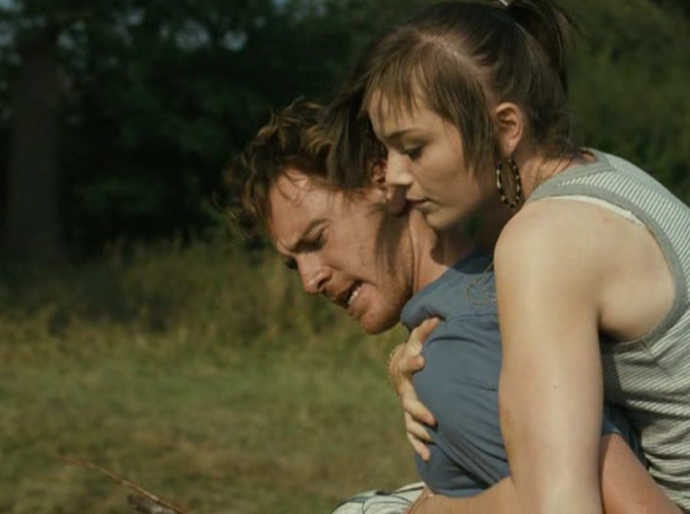
The theme romance is also important throughout the film as it shows how Mia gets along with other people. This is shown through performance. At 42:03 in the film it shows Connor and Mia dancing together until her mum interrupts. Mia then goes from happy to angry with Connor and storms off. This shows to the audience that Mia doesn’t feel as if anyone truly likes her for who she is and she doesn’t have anyone she trusts. It also shows that she Mia can’t hold on to people. Even though she does try and make friends, it doesn’t last long because something gets in the way (mainly her behaviour). The romance is important in this film because as it shows to the audience that nothing ever goes right for her. At 52:56 it shows Connor and Mia messing around, then Connor starts to it Mia in a jokey way. This foreshadows the events to come later on in the film when Mia takes Connors daughter and Connor hits Mia around her face. This also backs up the point that nothing goes well for Mia and that she loses everything she has.

An important scene within this film is when Mia is dancing in a small room with no one else is around. This is an important scene as it shows to the audience that she actually wants to do something with her life which is dancing. The fact that she is by herself, unlike the girls at the beginning of the film, shows that she wants to practice and that she wants to become a good dancer so she can escape living on the estate. This is important as the film is based around Mia wanting to change her life as she doesn't want to live on the estate anymore. This shows to the audience that she wants to make a change and that she does care about her life.

A comparable to this Fish Tank is 'Hick' (2011). The film is based about a girl who runs away to escape her unstable family and home life but runs into trouble along the way. This is similar to Fish Tank as both the protagonists want to escape their lives and move on to do better things. The film
'Hick' stars: Chloe Grace Moretz, Blake Lively, Eddie Redmayne. It was directed by: Derek Martini. It was written by: Andrea Portes.

In my opinion I thought that the film was good as it showed what it is really like living on an estate and the troubles young people face. However, I did not think that the storyline was that good as there was nothing that really grabbed my attention.

Saturday, 10 October 2015

Norman!!

Norman!
Writer: Talton Wingate
Director:  Jonathon Segal
Key Cast:  Emily VanCamp, Dan Byrd. Richard Jenkins
Genre: Comedy and Drama
Themes: Romance and Family
Release: June 2010

Narrative:
The film is about a student called Norman (Dan Byrd) who pretends to be dying of cancer in order to cope with his fathers (Richard Jenkins) terminal illness. He has to lie to everyone at school including his new girlfriend (Emily VanCamp). Rather than focusing on the tragedies themselves the film is about how Norman deals with the tragedies in his life including: losing his mother in a car accident, taking care of his father and his battle with depression.

Key Scenes:
One of the main scenes within the film is at 14:00 where Norman is pushed into auditioning for the school drama club. In his audition he explains how he had a dream where he would have a whole school assembly where he defies death by smashing through fake glass but then he shoots himself in front of everyone. He later explains how he actually tried to kill himself. No one is sure if he is being serious as they all act confused. Throughout his performance he is constantly laughing to himself and smiling. This is important as it show to the audience that he does not take death seriously and that he doesn't care about the effects that it will have on other people. He feels as if no one would really miss him. This is one way in which Norman’s depression is shown to the audience.

Compare:
This film is similar to “Perks of Being a Wallflower” as they are both about how they deal with the tragedies in their life. For example Charlie in “Perks of Being a Wallflower” likes to write about his everyday life and how he feels about the events he faces. It is not about the tragedies, but the aftermath. This is similar in Norman as it also shows how he deals with the problems in his life.

Although these two films have different story lines they both have the theme of love and family. These themes are important in both films as it shows how the tragedies they have faced have affected the simple things in life like relationships.